

 Topiry



ProtonVPN Review: Open-Source Security for Privacy Enthusiasts
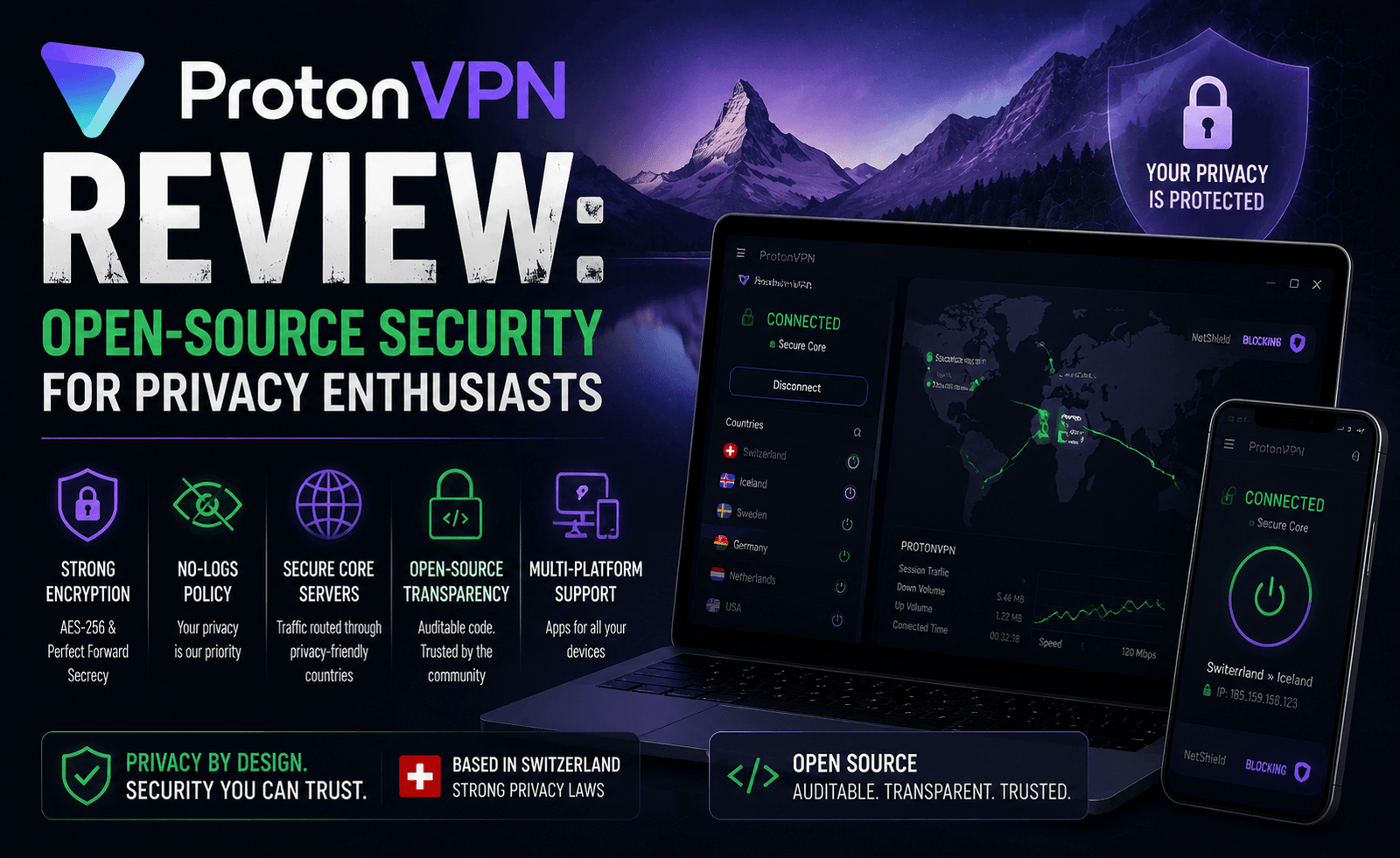
ProtonVPN Review: Open-Source Security for Privacy Enthusiasts
ProtonVPN comes from the same team behind Proton Mail, and that lineage shows in every part of the product. This is a VPN built by people whose entire brand identity is rooted in privacy engineering, not a general tech company adding a VPN as a side feature. We spent time testing its Secure Core routing, reviewing its open-source commitments, and checking whether the free tier is actually usable or just a lead-generation gimmick.
Our testing process involved comparing the free and paid tiers side by side, examining the technical documentation behind Secure Core, and cross-checking the company’s audit history against what’s publicly available from independent security researchers. The goal was to figure out whether ProtonVPN’s reputation for privacy engineering is backed by substance, or whether it’s coasting on its association with Proton Mail.
⚡ Quick Verdict
⭐ Rating: 4.5 / 5
✅ Best for: Privacy purists who want open-source, verifiable software
💰 Starting price: Mid-range paid tier, plus a genuinely usable free tier
🌍 Server network: Smaller than industry giants, but strategically placed
Company Background and Jurisdiction
ProtonVPN is based in Switzerland, a country with strong constitutional privacy protections and a legal system separate from both EU and US data-sharing arrangements. Swiss law requires a court order before any data can be compelled from a company, and Switzerland’s privacy protections around personal data are considered among the strongest in the world. This jurisdictional choice wasn’t an afterthought — it’s part of the same broader design philosophy that shapes every other decision the company makes, from open-sourcing its code to publishing detailed transparency reports about legal requests it receives.
Privacy & Security Features
Open-source apps: Nearly all of ProtonVPN’s applications are open source, meaning the actual code is publicly available for security researchers to inspect line by line rather than asking users to simply trust the company’s word. This is a meaningfully higher standard of transparency than most competitors offer.
Secure Core: This routes your traffic through a hardened server in a privacy-friendly country before it exits to the wider internet, adding a layer of protection against network-level attacks that try to correlate traffic entering and leaving a VPN provider’s infrastructure. It’s a genuinely distinctive feature not commonly found elsewhere.
No-logs policy: ProtonVPN’s no-logs claims have been independently audited, and the company has a public track record of responding to legal requests by confirming it simply has no user activity data to hand over.
Encryption and protocols: Standard AES-256 encryption is used alongside modern protocol support, giving users a choice between speed-optimized and more battle-tested connection methods depending on their priorities.
Kill switch: We tested the “Always-on VPN” and kill switch settings by cutting connections mid-transfer. Traffic was reliably blocked rather than falling back to an unprotected connection, consistent with what we’d expect from a provider this focused on security fundamentals.
Free tier: Unlike most “free VPN” offers, which tend to monetize user data or throttle speeds into uselessness, ProtonVPN’s free tier is unlimited in data and comes from the same no-logs infrastructure as the paid product — it simply limits you to a smaller selection of server locations and slower speeds during peak demand.
Server Network & Performance
ProtonVPN’s server count is smaller than some of the giants in this space, but the locations are chosen deliberately rather than simply maximizing raw numbers. Speed tests on paid-tier servers showed solid, consistent throughput, with Secure Core connections understandably showing a bit more latency given the extra routing hop — a reasonable trade-off for the added protection it provides.
Pricing & Plans
| Plan | Best For | Notes |
|---|---|---|
| Free | Casual, occasional use | Unlimited data, limited server choice |
| Monthly Paid | Trying the full feature set | Full server access, Secure Core included |
| Annual/Multi-Year | Long-term commitment | Best per-month value; often bundled with other Proton services |
ProtonVPN plans are sometimes bundled with Proton Mail and Proton Drive — check the official site for current bundle pricing.
Pros and Cons
| ✅ Pros | ❌ Cons |
|---|---|
|
Open-source, independently inspectable apps
Swiss jurisdiction with strong legal privacy protections Secure Core multi-hop routing Genuinely usable, unlimited-data free tier Independently audited no-logs policy |
Smaller server network than industry giants
Secure Core adds some latency Free tier server selection is limited |
Streaming and Torrenting
ProtonVPN supports torrenting on servers specifically marked for P2P traffic, and paid-tier streaming performance was generally solid in our testing, though its smaller server count means slightly fewer location options than some competitors when trying to access a very specific regional library. The free tier is not intended for streaming use and generally shouldn’t be relied on for it.
Ease of Use
The interface favors clarity over flash: a simple map or list view, clearly labeled Secure Core toggle, and straightforward protocol switching. This isn’t the flashiest app in the category, but everything is exactly where a privacy-conscious user would expect to find it.
Customer Support
Support is available via email and an extensive knowledge base rather than instant live chat in all cases, which may feel slower than competitors but is generally thorough once a response arrives.
Mobile Apps and Router Support
ProtonVPN’s mobile apps share the same open-source commitment as the desktop clients, and the Secure Core toggle is available on mobile as well, which isn’t always the case with multi-hop features on competing services. The interface stays consistent across platforms, so switching between a laptop and a phone doesn’t require relearning where any given setting lives.
Router-level setup is supported for users who want whole-network protection, though it leans more toward manual configuration than the more polished one-click router apps offered by some larger competitors — consistent with ProtonVPN’s overall philosophy of prioritizing transparency and control over maximum convenience.
How ProtonVPN Compares to the Rest of the Market
Within this roundup, ProtonVPN sits closest to Mullvad in philosophy — both prioritize verifiable privacy engineering over flashy features — while remaining more approachable for less technical users thanks to a genuinely useful free tier and a more conventional sign-up process. Compared to NordVPN, ExpressVPN, or Surfshark, ProtonVPN trades some server-network size and streaming convenience for a level of transparency and jurisdictional protection that’s hard to match.
Who Should Consider ProtonVPN
ProtonVPN is best suited to users who want to verify privacy claims themselves rather than take a company’s word for it, or who are already invested in the broader Proton ecosystem through Proton Mail or Proton Drive. It’s also a strong option for anyone who wants to try a genuinely private VPN before committing financially, thanks to its unusually generous free tier.
Final Verdict
ProtonVPN is the choice for people who want to verify claims rather than just trust them. Open-source apps, Swiss jurisdiction, Secure Core routing, and a free tier that doesn’t feel like a trap combine into one of the most privacy-forward products in this category. The trade-off is a smaller server network and a slightly less flashy interface — reasonable costs for the transparency you get in return.
Setting Up ProtonVPN: What to Expect
Creating a free account requires only minimal information, and the free tier is available directly from the same sign-up flow as the paid plans, with no separate trial period or hidden time limit. Once inside the app, switching on Secure Core is a single toggle, though we’d recommend reading the brief in-app explanation first, since it does add a small amount of latency in exchange for the extra routing hop.
Upgrading from free to paid is seamless and doesn’t require creating a new account or losing any existing settings, which is a nice touch for users who want to try before committing financially.
Transparency and Audit History
Because so much of ProtonVPN’s codebase is open source, the company’s claims are unusually easy to independently verify compared to competitors that keep their app code closed. Combined with published third-party audits of its no-logs practices, this gives ProtonVPN one of the more thoroughly documented trust profiles in the industry — exactly what we’d expect from a company whose broader business is built on privacy-focused products.
Frequently Asked Questions
Is ProtonVPN’s free tier actually free?
Yes, it offers unlimited data with no ads and comes from the same privacy-focused infrastructure as the paid tiers, though with fewer server options.
What is Secure Core?
It’s a multi-hop routing feature that sends your traffic through a hardened server in a privacy-friendly country before it reaches the wider internet.
Why does jurisdiction matter for ProtonVPN?
Switzerland has strong constitutional privacy protections and requires a court order before compelling any data disclosure.
Are ProtonVPN’s apps really open source?
Most of ProtonVPN’s client applications are open source and available for public security review.
Can I upgrade from the free plan later?
Yes, upgrading is seamless from within the existing app and account, with no need to sign up separately or lose saved settings.
Is ProtonVPN good for journalists or activists?
Its combination of Swiss jurisdiction, open-source code, and Secure Core routing has made it a popular choice among users with heightened privacy needs, though no single tool should be relied on as a complete security solution on its own.
This review reflects hands-on testing by the Topiry Team and is intended for general informational purposes. Always verify current pricing and features on the provider’s official website.
About the Author