

 Topiry



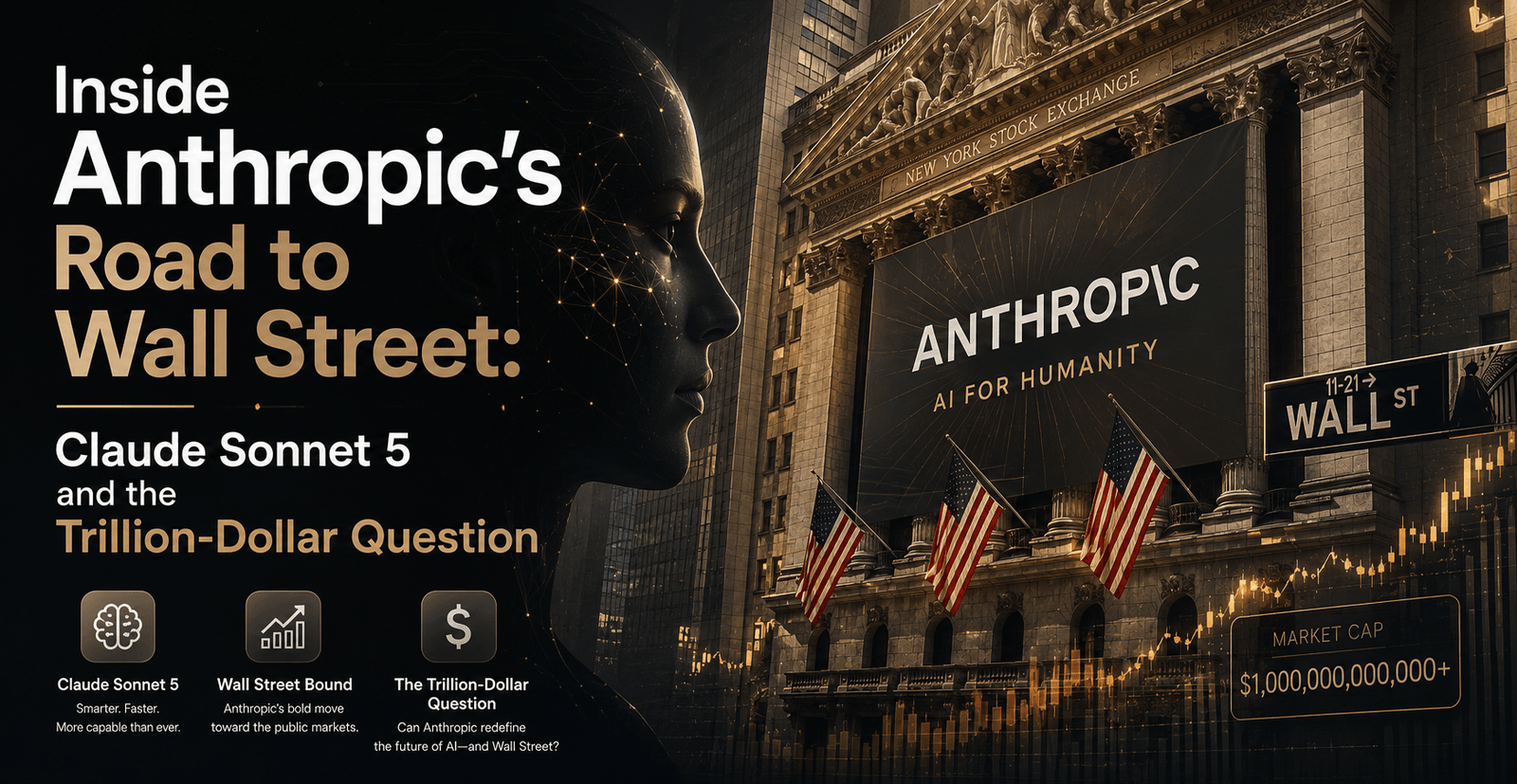
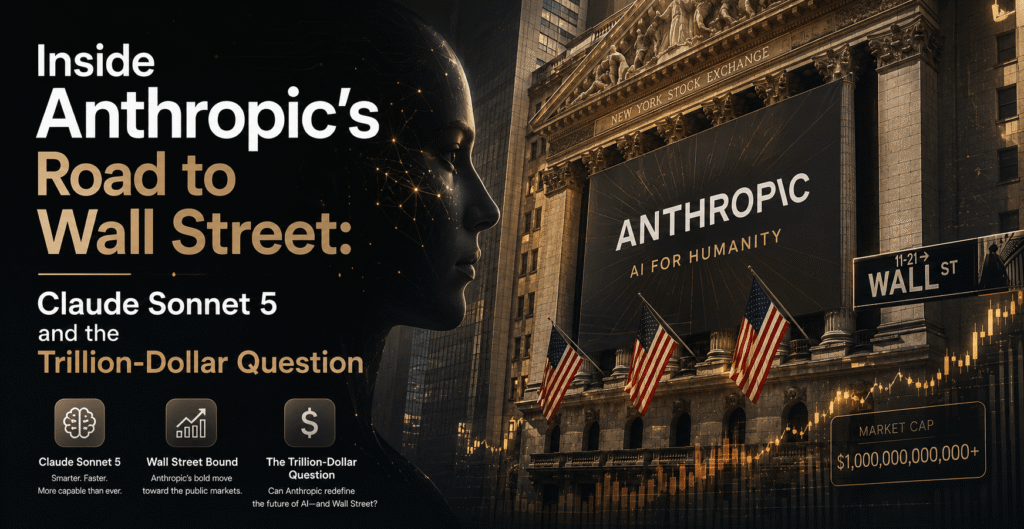
Inside Anthropic’s Road to Wall Street: Claude Sonnet 5 and the Trillion-Dollar Question
Inside Anthropic's Road to Wall Street: Claude Sonnet 5 and the Trillion-Dollar Question
At a Glance
- Anthropic confidentially filed a draft S-1 with the SEC on June 1, 2026, after closing a $65 billion Series H at a $965 billion valuation.
- Claude Sonnet 5 launched with introductory API pricing of $2 per million input tokens and $10 per million output tokens, undercutting the company’s own flagship model by a wide margin.
- Claude Code has reportedly reached roughly $2.5 billion in annualized revenue, with Anthropic-authored code estimated at around 4% of all public GitHub commits worldwide.
- Anthropic is also reportedly in early talks to lease AI computing capacity from Meta in a deal that could be worth around $10 billion.
Every few years, one company’s path to the public markets ends up defining how an entire industry gets valued. For AI in 2026, that company looks increasingly like Anthropic. Fresh off a $65 billion Series H round that valued it at $965 billion in late May, Anthropic confidentially filed a draft S-1 registration statement with the SEC on June 1, 2026 — becoming the first major frontier AI lab to formally begin the IPO process, ahead of rival OpenAI.
The filing came together with a notable roster: Goldman Sachs, JPMorgan, and Morgan Stanley were selected as lead underwriters, with Wilson Sonsini — the firm that guided Google through its 2004 IPO — brought in to help with public-market readiness. Analyst estimates for where Anthropic might eventually price place the potential valuation somewhere in the $1.1 to $1.25 trillion range, though those figures remain projections rather than terms Anthropic itself has confirmed.
Claude Sonnet 5: A Product Launch With a Second Purpose
Against that backdrop, Anthropic’s release of Claude Sonnet 5 reads as more than a routine model update. The new mid-tier model delivers performance that closely approaches the company’s flagship Opus 4.8 model, but at a fraction of the cost — introductory API pricing is set at $2 per million input tokens and $10 per million output tokens, roughly 60% cheaper than standard rates during the promotional period, before rising to $3 and $15 respectively after August 31, 2026. By comparison, Opus 4.8 is priced at $5 per million input tokens and $25 per million output tokens.
The model’s design emphasis is squarely agentic: the ability to plan multi-step tasks, operate browsers and terminals, and run extended workflows with minimal human supervision, reflecting where enterprise demand has clearly moved in 2026. Disclosed benchmark results show meaningful gains over its predecessor, Sonnet 4.6 — on SWE-bench Pro, an agentic coding evaluation, Sonnet 5 scores 63.2%, up from Sonnet 4.6’s 58.1%, putting it within striking distance of the considerably more expensive Opus 4.8.
Why Price the Model This Aggressively?
The strategic logic behind Sonnet 5’s pricing is not subtle. A model good enough to substitute for flagship-tier work in many enterprise use cases, priced cheaply enough to run at genuine scale, directly targets the objection that has slowed enterprise AI adoption more than any capability gap: cost per task. For developers, Sonnet 5 offers a real capability upgrade at a competitive price. For Anthropic’s IPO narrative, it offers something arguably more valuable — evidence that the company can grow usage and revenue without flagship-level pricing, addressing concerns that frontier AI economics only work at the very top of the market.
Financial analysts following the IPO process have suggested that the number that will ultimately validate or undercut the entire private-market narrative around Anthropic isn’t the headline valuation or even the topline revenue figure — it’s gross margin, a number no outside observer has yet seen in detail.
The Business Behind the Model
The numbers underpinning Anthropic’s IPO case are genuinely striking. Claude Code, the company’s agentic coding product, is reported to have reached roughly $2.5 billion in annualized revenue by February 2026, with enterprise customers accounting for more than half of that figure and reportedly including large, recognizable names in retail, financial services, and consumer technology. One widely cited estimate places Anthropic-authored code at around 4% of all public commits on GitHub globally — a genuinely remarkable figure for how deeply an AI coding tool has embedded itself into everyday software development in a relatively short period.
Total API revenue, generated as enterprises access Claude models through cloud platforms and direct integration, is projected to reach roughly $3.8 billion in 2026 — more than double what OpenAI is projected to generate from its own API business over the same period, according to industry estimates. That gap is notable given how much more OpenAI’s consumer ChatGPT product dominates headlines; it suggests Anthropic’s enterprise-first strategy, built around coding and agentic workflows rather than a mass-market chatbot, has produced a meaningfully different and in some ways more durable revenue mix.
A Compute Deal With an Unlikely Partner
Perhaps the most unexpected recent development is a report that Anthropic is in early, preliminary talks to lease AI computing capacity from Meta, in a deal that could be worth in the neighborhood of $10 billion. If it materializes, it would be a striking example of how thoroughly the old lines between AI competitors have blurred — two companies that compete for the same enterprise and developer mindshare potentially becoming compute customer and compute supplier, driven by the simple reality that demand for training and inference capacity continues to outstrip what any single company can build alone.
Headwinds on the Way to Nasdaq
The road to a public listing has not been entirely smooth. Anthropic’s most advanced model tier faced a temporary suspension in mid-June tied to export control requirements, before access was restored at the start of July — a reminder that even the most well-capitalized AI labs remain exposed to fast-moving regulatory decisions well outside their control. Analysts modeling Anthropic’s financial trajectory note that the episode stretched out some of their delay assumptions for the IPO timeline, even as it demonstrated that the company’s core revenue engines, built primarily on its more widely deployed model tiers, kept compounding through the disruption largely unaffected.
Broader questions about the IPO market itself also loom over the process. One PitchBook analyst quoted by CNBC framed 2026 as a year that will either produce the most consequential IPO cycle since the dot-com era, or teach public markets an expensive lesson about the gap between narrative and fundamentals. Anthropic’s bet, in effect, is that a model as capable as its flagship and priced cheaply enough to run at real scale is exactly the kind of evidence that tips the outcome toward the former.
What to Watch
With a confidential S-1 already filed and underwriters selected, the practical questions ahead are about timing and terms rather than whether an IPO happens at all. Estimates for a public listing window have ranged from an October 2026 target to later projections stretching into December, with the wide range itself reflecting how much uncertainty still surrounds a process this large and this closely watched. Whatever the final timeline, Anthropic’s public filing, once it moves from confidential to public, will offer the AI industry something it has never had: a genuine, audited look inside the finances of a frontier AI lab, gross margins included.
Racing OpenAI to the Public Markets
Anthropic’s decision to file first carries strategic weight that goes beyond simple timing. As of early June, OpenAI had raised substantial capital at an $852 billion valuation but had not yet filed for its own public listing. By moving first, Anthropic effectively gets to help set the template for how a frontier AI lab discloses its finances, structures its governance, and reports on model risk to public-market investors — a precedent that will inevitably shape how the entire category gets valued once more labs follow. Being first to file is not merely a bragging point; it hands Anthropic a genuine role in defining the disclosure norms that OpenAI, and any AI company that goes public after it, will effectively be measured against by comparison.
That first-mover positioning is reinforced by the valuation reversal between the two companies. Anthropic’s $965 billion Series H valuation now sits ahead of OpenAI’s $852 billion mark, a striking reordering that would have seemed unlikely to most observers as recently as two years ago, when OpenAI’s early and dominant lead in consumer AI made it the presumptive frontrunner in almost every conversation about which lab would reach public markets first and at the highest valuation. Anthropic’s enterprise-and-coding-first strategy, anchored by Claude Code’s rapid revenue growth, appears to have been the more durable bet, at least by the metric that matters most heading into an IPO: demonstrable, recurring enterprise revenue rather than viral consumer usage alone.
What a Public Anthropic Means for Everyone Else
For enterprises and developers who rely on Claude models today, the practical question raised by all of this is what going public actually changes about the day-to-day experience of building on Anthropic’s platform. Public companies generally face more predictable, more heavily scrutinized reporting cycles, which can translate into more conservative, more carefully telegraphed pricing changes rather than the abrupt adjustments private companies can sometimes make with less external accountability. It can also mean more pressure to demonstrate steadily improving margins each quarter, which is precisely why analysts have zeroed in on gross margin as the figure that will make or break how the market receives the eventual public filing.
For competitors, an Anthropic IPO sets a public benchmark that has never existed before: audited financials from a frontier AI lab, showing exactly how much it costs to serve a given amount of inference, how quickly enterprise revenue is actually growing versus how quickly it’s merely being announced, and how compute costs move as a share of revenue as the company scales. That transparency, once it exists, will be difficult for any other AI lab to avoid being compared against, whether or not they have any plans to go public themselves in the near term.
Topiry will continue following Anthropic’s IPO process, including any updates to the underwriting terms, timeline, and public S-1 filing as they become available.
About the Author