

 Topiry



Free vs Paid Mobile VPN Apps: Which One Actually Protects You in 2026?
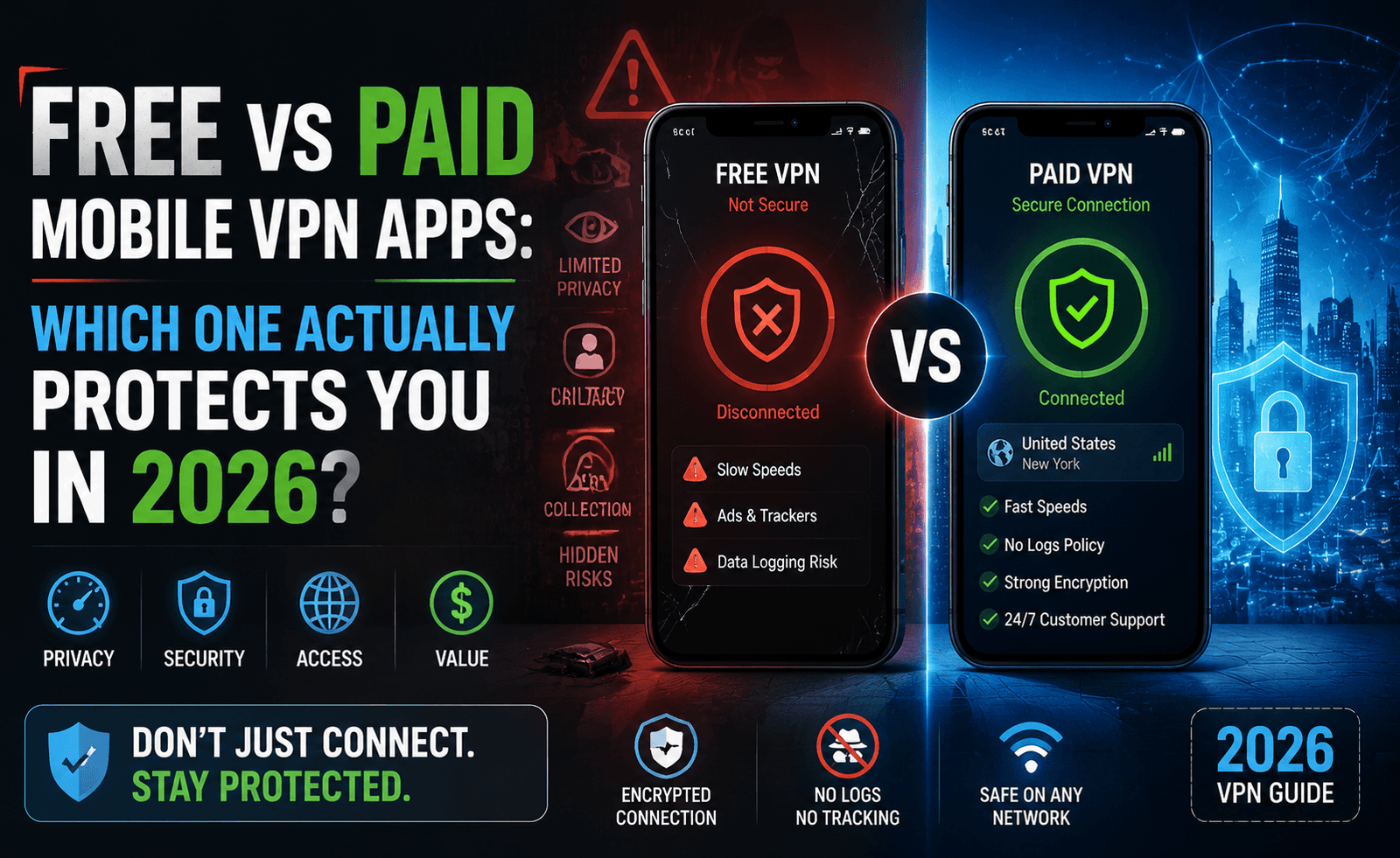
“Free VPN” is one of the most-searched phrases in the app stores, and it’s easy to understand why — paying a monthly subscription just to browse the internet feels unnecessary when a free download promises the same result. Unfortunately, the VPN industry has a well-documented history of free apps that quietly undermine the exact privacy promise users are looking for. We dug into how free mobile VPNs typically make money, when a free tier is actually reasonable, and how to tell the difference before you install anything.
How Do Free VPNs Actually Make Money?
Running VPN server infrastructure isn’t free, so any VPN offered at no cost needs a revenue model somewhere. In practice, mobile free VPN apps tend to fall into a few categories:
- Data collection and resale: some free VPN apps collect browsing data or device information and sell it to advertising networks — the exact activity a VPN is supposed to protect you from in the first place.
- Ad-supported free tiers: a legitimate paid provider offers a limited free plan supported by in-app ads or data caps, without touching your browsing activity.
- Freemium upsells: a genuinely limited free tier (fewer servers, capped speed, or a monthly data limit) that’s designed to convert users to a paid plan over time.
- Bundled malware: in rarer but well-documented cases, free VPN apps distributed outside official app stores have bundled malicious code alongside the advertised VPN functionality.
Red Flags to Watch For
Before installing any free mobile VPN, it’s worth running through a short mental checklist:
- No published privacy policy, or one that’s vague about data collection. A legitimate provider will clearly state what it does and doesn’t log.
- No parent company or business information available. If you can’t find out who actually operates the service, that’s a meaningful warning sign.
- Excessive permission requests. A VPN app asking for access to your contacts, camera, or SMS messages has no legitimate reason to need that data.
- Unusually high app-store rating with mostly generic reviews. This can sometimes indicate review manipulation.
- No mention of encryption protocol or technical details anywhere in the app or its store listing. Reputable providers are usually happy to describe their technology.
When a Free Mobile VPN Is Actually Fine
Not every free VPN deserves suspicion. A small number of reputable paid providers offer genuinely limited free tiers as a way to build trust and demonstrate their product before asking for a subscription. Proton VPN’s free tier is a commonly cited example: it’s operated by an established, audited company, doesn’t sell user data, and its main limitation is a smaller selection of available server locations rather than any compromise on privacy.
The pattern to look for is simple: a free tier attached to a paid company you can independently research is a very different situation than a standalone “free VPN” app with no clear business model behind it.
What You Actually Get With a Paid Mobile VPN
| Feature | Typical Free VPN | Reputable Paid VPN |
|---|---|---|
| Data or speed caps | Common | Rare or none |
| Server locations | Very limited | Dozens of countries or more |
| Independently audited no-logs policy | Uncommon | Increasingly standard among top providers |
| Kill switch and split tunneling | Rarely included | Standard feature |
| Customer support | Minimal or none | Live chat and email support |
| Revenue model | Often unclear | Transparent subscription fee |
How Much Does a Reputable Paid VPN Actually Cost?
This is where the “free vs paid” decision gets easier than it first appears. Nearly every major provider — NordVPN, ExpressVPN, Surfshark, Proton VPN — discounts its long-term plans heavily compared to monthly billing. Over a two-year commitment, the effective monthly cost of a reputable paid VPN often works out to less than a single coffee shop drink, which is a fairly low price for meaningfully better privacy guarantees, faster speeds, and actual customer support if something goes wrong.
Our Recommendation
If your goal is genuine privacy and security — not just avoiding a subscription fee — a paid plan from an established, independently audited provider is almost always the better choice. If budget is a hard constraint, Proton VPN’s free tier is the most defensible free option currently available, precisely because it’s backed by a company with a transparent, verifiable business model rather than an unclear one.
A Simple Framework for Deciding
Rather than trying to memorize every red flag, it can help to run through three straightforward questions before installing any mobile VPN, free or paid:
- Who operates this app, and can I verify it independently? A quick search should turn up a company name, headquarters, and some history — not just an app store listing with no further information.
- How does this company make money? If the answer isn’t obvious from the pricing page or privacy policy, that’s worth treating as a warning sign rather than a minor omission.
- Has the no-logs claim been independently verified? An audit doesn’t guarantee perfection, but it’s a meaningfully stronger signal than a policy nobody outside the company has ever reviewed.
If you can answer all three clearly and the answers hold up, a free tier can be a reasonable choice for light, occasional use. If any of the three questions leads to a dead end, it’s safer to assume the app is monetizing your data in some way you can’t currently see.
What About Built-In VPNs on Browsers and Phones?
Many mobile browsers now advertise a built-in “VPN” or “secure browsing” feature, and some phone manufacturers bundle a basic VPN-like tool into their own security app. These are usually more limited than they sound — often they only protect browser traffic rather than your entire device, and their privacy policies deserve the same scrutiny as any standalone VPN app. They can be a reasonable lightweight option for casual browsing, but they generally shouldn’t be relied on for anything involving banking, sensitive communication, or travel to networks you don’t trust.
A Note on App Store Reviews
It’s tempting to use app store star ratings as a shortcut for trustworthiness, but ratings are one of the easiest signals to manipulate and one of the least reliable indicators of a VPN’s actual privacy practices. A high rating tells you the app is easy to use and rarely crashes — it tells you almost nothing about what happens to your data on the back end. Independent audits, transparent company information, and a clear privacy policy remain far more reliable signals than star ratings alone.
Frequently Asked Questions
Is it illegal to use a free VPN?
No, using a VPN — free or paid — is legal in most countries. The concern with free VPNs is about data privacy and business practices, not legality.
Can a free VPN app steal my data even if I don’t enter any personal information?
Yes. A VPN app sits in the middle of all your internet traffic by design, so a poorly-behaved app can observe browsing activity, app usage patterns, and device information without you ever typing anything into it directly.
Are the free tiers of paid VPNs safe long-term, or just a trial?
It depends on the provider. Some, like Proton VPN, offer a genuinely permanent free tier with reduced features rather than a time-limited trial — it’s worth checking the specific terms before assuming either way.
Why do free VPNs so often have slower speeds than paid ones?
Server infrastructure costs money to run and expand, so free services typically operate a much smaller pool of servers shared among a large number of users, which naturally leads to more congestion than a paid provider’s larger, better-maintained network.
Is it worth paying for a VPN if I only use public Wi-Fi occasionally?
Even occasional exposure to shared or public networks is a meaningful risk window, so if you value your data at all, a low-cost long-term plan from a reputable paid provider is generally worth it over relying on an unclear free alternative.
Final Thoughts
The free-versus-paid decision for mobile VPNs really comes down to one question: who is actually paying for the servers you’re connecting through, and how transparent are they about it? When you can answer that clearly and the answer checks out, a free tier can be a reasonable choice. When you can’t answer it at all, that uncertainty is itself the biggest privacy risk in the equation — often bigger than whatever risk you were trying to avoid by using a VPN in the first place.
If you take away one habit from this guide, let it be this: before installing any mobile VPN, free or paid, spend two minutes checking who runs it and how it makes money. That small amount of due diligence will filter out the overwhelming majority of genuinely risky free VPN apps, and it costs far less time than dealing with the consequences of trusting the wrong one with your entire phone’s traffic.
About the Author