

 Topiry



Roblox’s AI ‘Build’ Feature Puts Text-to-Game Creation on a Collision Course With Developers
Roblox's AI 'Build' Feature Puts Text-to-Game Creation on a Collision Course With Developers
Type a Sentence, Get a Game
Generative AI has spent the past few years working its way through text, images, video, and code. The next frontier turns out to be something more ambitious: entire playable games, generated from little more than a sentence. Roblox’s newly announced “Build” feature is the clearest signal yet that this shift is no longer experimental, and the reaction it has provoked, ranging from genuine excitement among aspiring creators to real alarm among professional developers, captures a tension that is likely to define the next phase of the software industry’s relationship with generative AI.
What Build Actually Does
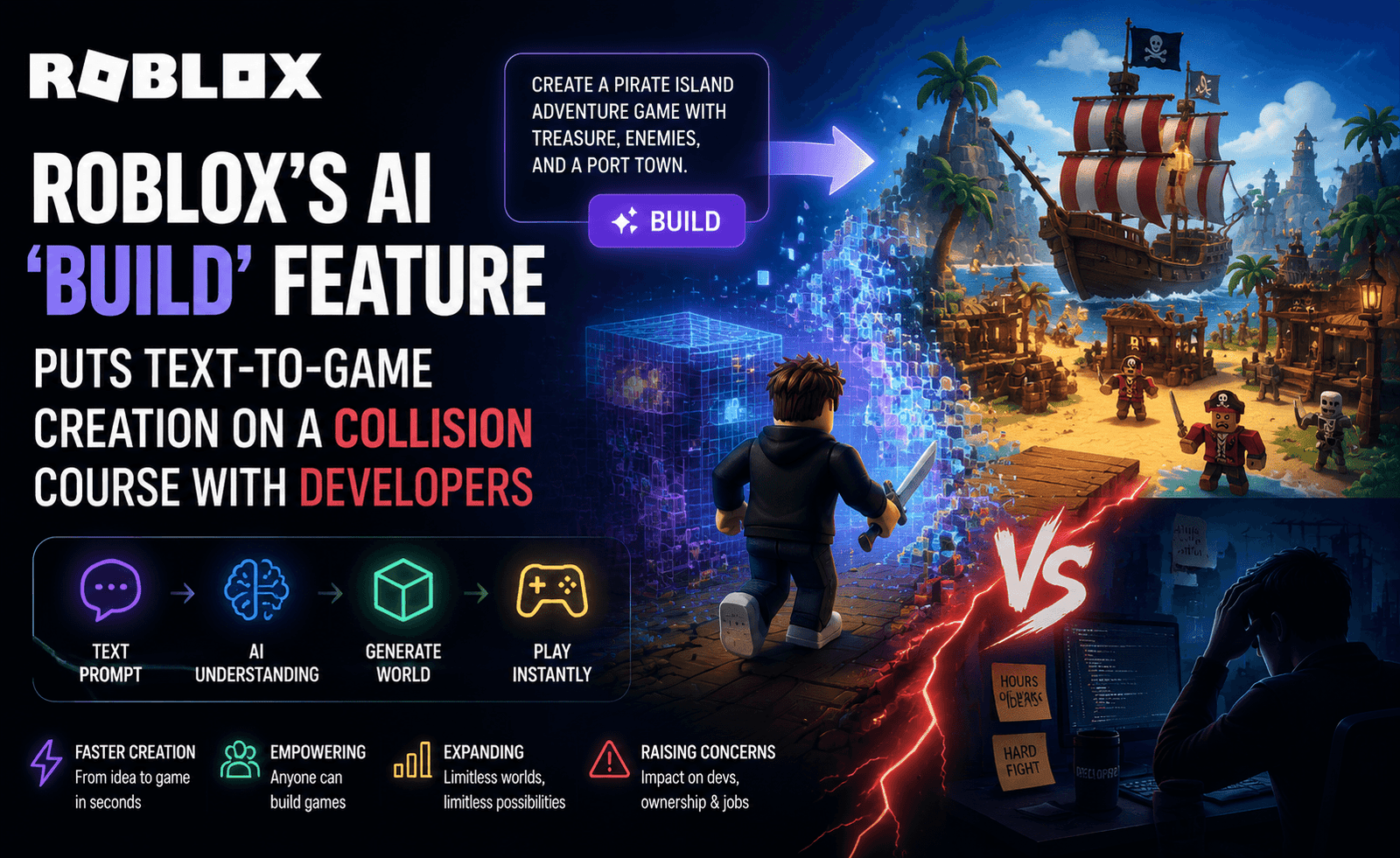
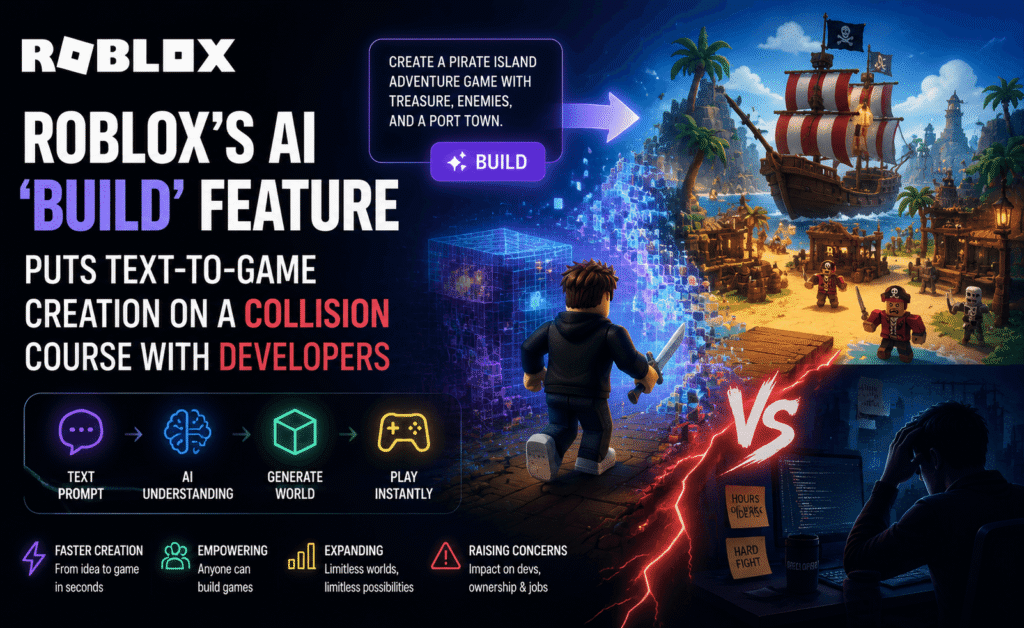
The mechanics are deceptively simple. A user opens the Roblox mobile app, types a description such as wanting a cozy adventure game set in a dense forest, and the system generates a working initial version covering gameplay mechanics, environment layout, character design, visual style, and even sound, all without the user writing a single line of code. From there, the creator can modify whatever the system produced and publish it for others to play. According to Roblox’s own description of the feature, it runs on a mix of proprietary Roblox models and open-source components, reflecting a broader industry pattern where companies increasingly blend in-house and openly available models rather than relying entirely on either approach.
Build is entering public alpha testing first in New Zealand, available to users aged nine and older with verified ages, before a broader regional rollout that Roblox says will follow. The company plans to offer both free and paid tiers, and it is pairing the launch with additional AI tooling aimed at creators, including agents designed to help with playtesting and analytics, extending a set of AI features Roblox has already built out over the past two years, including a scripting assistant for existing developers and a separate model for generating 3D assets from text descriptions.
Roblox is not alone in pursuing this category. Google, Microsoft, and Tencent have all built comparable AI-driven game generation tools, and industry watchers view Build less as a singular breakthrough and more as confirmation that text-to-game generation has become a competitive front nearly every major platform with a creator ecosystem now feels obligated to compete on.
The Business Model Question Nobody Has Fully Answered
Underneath the product announcement sits a genuinely thorny business question that Roblox has not yet fully resolved in public. The platform has built its entire business around user-generated content, paying out hundreds of millions of dollars annually to creators through its developer exchange program. Build could dramatically widen who is capable of making a game on the platform, from a relatively small pool of people willing to learn to code to, in principle, anyone who can describe an idea in a sentence. But it leaves open how revenue-sharing works for a game whose gameplay mechanics, environment, and characters were substantially generated by Roblox’s own models rather than authored by the person who receives credit for publishing it, and how that arrangement will be perceived by developers who invested years learning to build these systems by hand.
How Roblox ultimately answers that question is likely to shape whether its most established, highest-earning creators view Build as a tool that expands their own creative reach, or as a competitor that devalues the specific skill set they spent years developing. Early reactions from within the creator community have split along roughly those lines, with some younger developers describing the tool as removing the tedious parts of asset creation so they can focus on ideas and design, while others worry openly about what happens to the market for hand-built games once a meaningful share of new content on the platform can be generated in seconds.
A Developer Community Already on Edge
That worry is not coming out of nowhere. This year’s Game Developer Conference State of the Game Industry survey found that 52 percent of industry professionals believe generative AI is having a negative overall impact on the field, a striking figure for a technology that, in other software categories, has generally been received with more enthusiasm than dread. The concern driving that number is fairly specific: critics argue that dramatically lowering the barrier to entry for game creation risks flooding platforms with low-effort, repetitive, derivative content, making it harder for genuinely original, carefully crafted games to find an audience amid the noise.
Roblox’s proposed answer to that concern is to lean on its existing discovery system, which already ranks content based on player retention rather than novelty or publication date. The company’s argument is that AI-generated games without real staying power simply will not surface prominently, regardless of how many of them get published, effectively letting player behavior act as the quality filter rather than any kind of upfront moderation or gatekeeping. Whether that system holds up once the volume of AI-generated submissions increases by an order of magnitude, which seems like a reasonable expectation once a text-prompt game creator is available globally on mobile, is one of the more consequential open questions hanging over this launch.
Part of a Much Bigger Industry Moment
Build’s launch lands amid a broader stretch of AI industry news that, taken together, paints a picture of a sector simultaneously chasing extraordinary valuations, making enormous infrastructure bets, and grappling with unresolved questions about what all this technology is actually doing to the people and institutions built around it. Funding rounds for AI startups have continued to rewrite expectations for what a young AI company can be worth, even before it has demonstrated durable revenue. Energy companies are placing multi-billion-dollar bets on advanced power generation to keep pace with AI infrastructure demand, years before some of those technologies have been proven commercially viable at scale. And a growing body of research into the behavior of advanced AI models has begun raising questions about the psychological complexity of the systems now embedded in everyday consumer products, well beyond what casual users of chatbots and AI assistants typically assume they are interacting with.
Text-to-game generation sits squarely at the intersection of several of those threads: it is a direct product of the same frontier model capabilities driving enterprise AI adoption elsewhere in the software industry, it depends on the same underlying infrastructure buildout drawing enormous capital investment, and it raises the same fundamental question showing up across creative industries this year, from writing to illustration to music, about what happens to a profession once the tools that once required years of specialized training become accessible to anyone willing to type a sentence.
What to Watch as Build Expands Beyond Alpha
For the games industry specifically, the next few months of Build’s rollout are likely to serve as an early, closely watched test case for questions that will eventually confront nearly every creative software category. Does player-driven discovery actually filter out low-effort AI content at scale, or does volume overwhelm even a well-designed ranking system? Does opening game creation to a much larger pool of casual creators grow the overall pie for the platform and its existing developers, or does it primarily redistribute attention and revenue away from the professionals who built the ecosystem in the first place? And how will Roblox, and the platforms following its lead, handle compensation and creative credit once a meaningful share of the content flowing through their systems was substantially shaped by the platform’s own AI rather than solely by the human who hit publish.
None of these questions have clean answers yet, and Roblox’s own public statements suggest the company is aware it is navigating genuinely contested territory rather than rolling out an uncomplicated new feature. What is clear is that the shift from AI generating supporting assets for games to AI generating entire playable experiences from a single prompt has now moved from a research demo to a live product used by millions of people, and the industry’s response to how that plays out over the coming year is likely to shape how aggressively other major platforms move on similar tools of their own.
The Longer View
Zoom out far enough and Build looks like a natural, if unusually fast, extension of a trend that has been building across creative software for several years: the steady collapse of the distance between having an idea and producing a finished, shareable artifact based on it. Word processors and desktop publishing software did this for writing decades ago; digital audio workstations did it for music production; no-code website builders did it for basic web development. Each of those shifts produced a similar wave of anxiety among incumbent professionals, followed eventually by a reshaping of the profession rather than its disappearance, with skilled practitioners differentiating themselves through judgment, taste, and the ability to push past what the default tooling produces on its own.
Whether game development follows that same arc, or whether the interactive, systems-heavy nature of games makes it a genuinely different case, is not yet settled, and reasonable people inside the industry currently disagree about which outcome is more likely. What does seem clear is that the debate is no longer theoretical. With a major platform reaching hundreds of millions of users now shipping a text-to-game tool directly into its mobile app, the industry is about to get real, large-scale data on how this plays out, rather than continuing to argue about it in the abstract.
About the Author