

 Topiry



Best AI Coding Assistants of 2026: Complete Comparison Guide
The AI coding assistant market has gone from a handful of autocomplete plugins to a genuinely crowded field of editors, terminal agents, and hybrid platforms — each with a different philosophy about how much of the coding process should be handed over to a model. After spending weeks testing the leading tools side by side for our individual in-depth reviews, we’ve pulled everything together into one buying guide to help you cut through the noise and pick the right assistant for your workflow.
The Four Tools We Compared
- GitHub Copilot — the broadest platform, spanning completions, chat, agent mode, a CLI, and code review, deeply woven into the GitHub ecosystem.
- Cursor — an AI-native VS Code fork built around Composer, its multi-file agentic editing experience, with genuine multi-model flexibility.
- Claude Code — Anthropic’s terminal-first agent, built for handing off entire tasks rather than watching every keystroke.
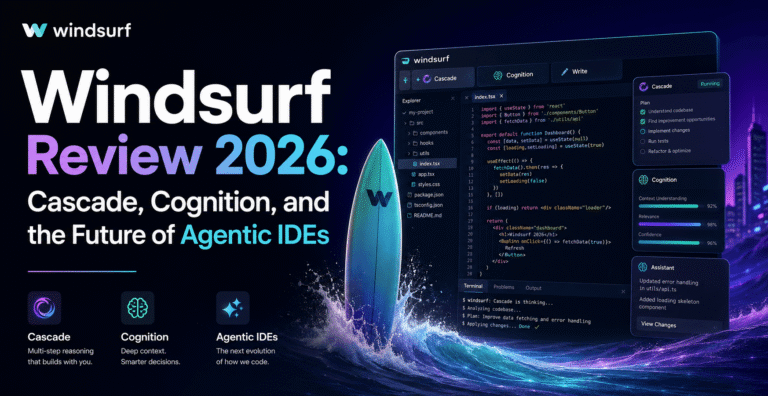
- Windsurf — Cognition’s fast, focused agentic editor, built around the Cascade agent and Fast Context.
Head-to-Head Comparison
| Tool | Entry Price | Best For | Standout Feature | Biggest Limitation |
|---|---|---|---|---|
| GitHub Copilot | ~$10/month | Teams already living in GitHub | Unlimited, unmetered completions | Credit system across five different surfaces |
| Cursor | ~$20/month | Developers wanting the deepest agentic editor | Composer multi-file editing | Usage-based costs can climb with frontier models |
| Claude Code | ~$20/month | Handing off entire tickets to an autonomous agent | Plan Mode and Agent Teams | Terminal-first learning curve |
| Windsurf | $0–~$20/month | Speed-focused day-to-day editing | Cascade + Fast Context response speed | Narrower model selection |
Pricing across this entire category changes frequently and every vendor listed here has revised its plans at least once in the last twelve months. Treat the figures as a general reference point, not a locked-in quote, and check each vendor’s official pricing page before making a purchasing decision.
How to Choose Based on Your Workflow
If your team already lives inside GitHub
GitHub Copilot is the path of least resistance. Its native integration with pull requests, Actions, and Issues means less friction for procurement and rollout, and the unlimited completions tier is a safe, low-anxiety default for developers who don’t want to think hard about a new tool.
If you want the single most capable in-editor agentic experience
Cursor remains the benchmark for multi-file agentic editing inside a graphical IDE. If your work involves frequent, complex refactors and you want the flexibility to pick between several frontier models depending on the task, Cursor’s Composer is still the one to beat.
If you want to hand off entire tasks and check in only at key moments
Claude Code is built for exactly this mode of working. Its Plan Mode gives you a cheap early checkpoint, and its Agent Teams feature lets you parallelize work across a larger project. It suits developers comfortable thinking in terms of tickets rather than keystrokes.
If speed and simplicity matter more than model choice
Windsurf’s Cascade is consistently the fastest agent we tested for iterative, back-and-forth work, and its generous free tier makes it an easy way to try the category without committing money upfront.
Beyond the Big Four: Other Tools Worth Knowing About
While Copilot, Cursor, Claude Code, and Windsurf dominate the current conversation, a handful of other tools are worth keeping an eye on depending on your situation:
- Amazon Q Developer — a natural fit for teams heavily invested in AWS infrastructure, with tight integration into AWS-specific services and IAM permissions.
- Tabnine — popular with regulated industries thanks to strong on-premises and private-model deployment options.
- Aider and Cline — open-source, bring-your-own-API-key terminal tools favored by developers who want full control over which model powers their agent without a vendor subscription.
- Replit AI, Bolt, and Lovable — full-stack app builders aimed more at rapidly prototyping and shipping complete applications than at editing an existing large codebase.
A Word on Cost Management
Almost every tool in this category has moved, or is moving, toward usage-based billing layered on top of a base subscription. That shift reflects the real economics of running frontier models, but it also means the “sticker price” on a pricing page is increasingly just a starting point rather than your actual monthly cost. A few practices apply across every tool in this guide:
- Reserve your most expensive model tier for genuinely hard, multi-file reasoning tasks, and let cheaper models handle routine work.
- Keep project-level instructions (CLAUDE.md, .cursorrules, or equivalent) lean — they’re re-sent on every request and bloated instructions quietly compound cost over long sessions.
- Start fresh sessions for unrelated tasks rather than letting one long conversation accumulate an ever-growing history that has to be re-processed on every turn.
- For teams, set organization-level budget caps early rather than reactively, since a single enthusiastic agent user can otherwise run up a surprising bill by mid-month.
How These Tools Handle Security and Compliance
Security posture varies more across this category than most feature comparisons let on. GitHub Copilot’s Business and Enterprise tiers lead on IP indemnity and audit logging, which tends to matter most to larger, more risk-averse organizations. Cursor’s Privacy Mode and Enterprise SSO cover most mid-market needs, though its multi-provider model routing means legal teams should confirm exactly which underlying model vendors are in scope. Claude Code inherits Anthropic’s account-level data-handling terms, with Team and Enterprise tiers adding centralized admin controls. Windsurf’s Enterprise tier bundles RBAC and SSO/SCIM as included features, with hybrid deployment for regulated industries still listed as forthcoming. None of these tools should be rolled out organization-wide without a short internal review of exactly which tier’s terms apply to your specific compliance requirements.
Common Mistakes Teams Make When Adopting AI Coding Tools
Across dozens of team rollouts we’ve observed or discussed with engineering leaders, the same few mistakes come up repeatedly. The first is picking a tool based purely on a benchmark leaderboard rather than a real task from the team’s own codebase — benchmark performance and real-world usefulness on a messy, years-old repository often diverge more than vendors’ marketing suggests. The second is skipping any lightweight training on prompt structure, which leads to a small group of power users getting outsized value while the rest of the team barely uses the tool at all. The third is failing to set organization-level spending caps before rollout, which on usage-based plans can lead to an unpleasant budget surprise by the second or third month. None of these mistakes are hard to avoid, but all three are common enough to be worth calling out explicitly before you sign a team-wide contract.
A Simple Framework for Deciding
If you only have time to answer one question before choosing, make it this: do you want to watch and steer every change, or hand off a task and check in later? Developers who answered “watch and steer” in our testing were consistently happiest with Cursor or Windsurf, depending on whether they valued model choice or raw speed more. Developers who answered “hand off and check in later” were consistently happiest with Claude Code. And teams whose honest answer was “we haven’t thought about it that hard, we just want something that works inside GitHub” were, unsurprisingly, happiest sticking with Copilot. There’s no wrong answer here — just a mismatch to avoid between how you actually want to work and which tool’s philosophy you’ve adopted by default.
Looking Ahead: Where This Category Is Heading
Every vendor in this comparison is racing toward the same rough destination: an assistant capable of taking on larger, longer-running, more autonomous chunks of work with less supervision, while still giving developers an easy way to step in and course-correct. Cognition’s plan to fold Devin’s autonomous capabilities into Windsurf, GitHub’s steady expansion of Copilot’s CLI and Code Review surfaces, and Anthropic’s continued investment in Claude Code’s Agent Teams feature are all different bets on the same underlying trend. The practical implication for buyers is that whichever tool you choose today is unlikely to look the same in twelve months — which is exactly why we plan to revisit this comparison regularly rather than treating any single review as a permanent verdict.
Final Recommendation
There’s no single “best” AI coding assistant in 2026 — there’s a best assistant for your specific workflow. Teams anchored in GitHub should default to Copilot. Developers who want the deepest agentic editing experience should look at Cursor. Anyone comfortable handing off whole tickets and checking in periodically should give Claude Code a serious trial. And developers who prioritize speed and simplicity above all else will likely be happiest with Windsurf. The good news is that switching costs in this category are lower than they’ve ever been — most of these tools offer a free or low-cost tier, so the most reliable way to decide is still to try two or three of them against a real task from your own codebase.
Whichever tool you land on, resist the temptation to treat the decision as permanent. The pace of change in this category over just the past year — new pricing models, new agent capabilities, a major acquisition — means the right answer for your team six months from now may not be the same as the right answer today. Revisit the comparison periodically, keep an eye on what your own developers reach for organically even when a different tool is the official standard, and don’t be afraid to run two tools in parallel if different parts of your workflow genuinely benefit from different strengths.
About the Author