

 Topiry



Nioh 3 Review: Team Ninja’s Open-Field Gamble Pays Off
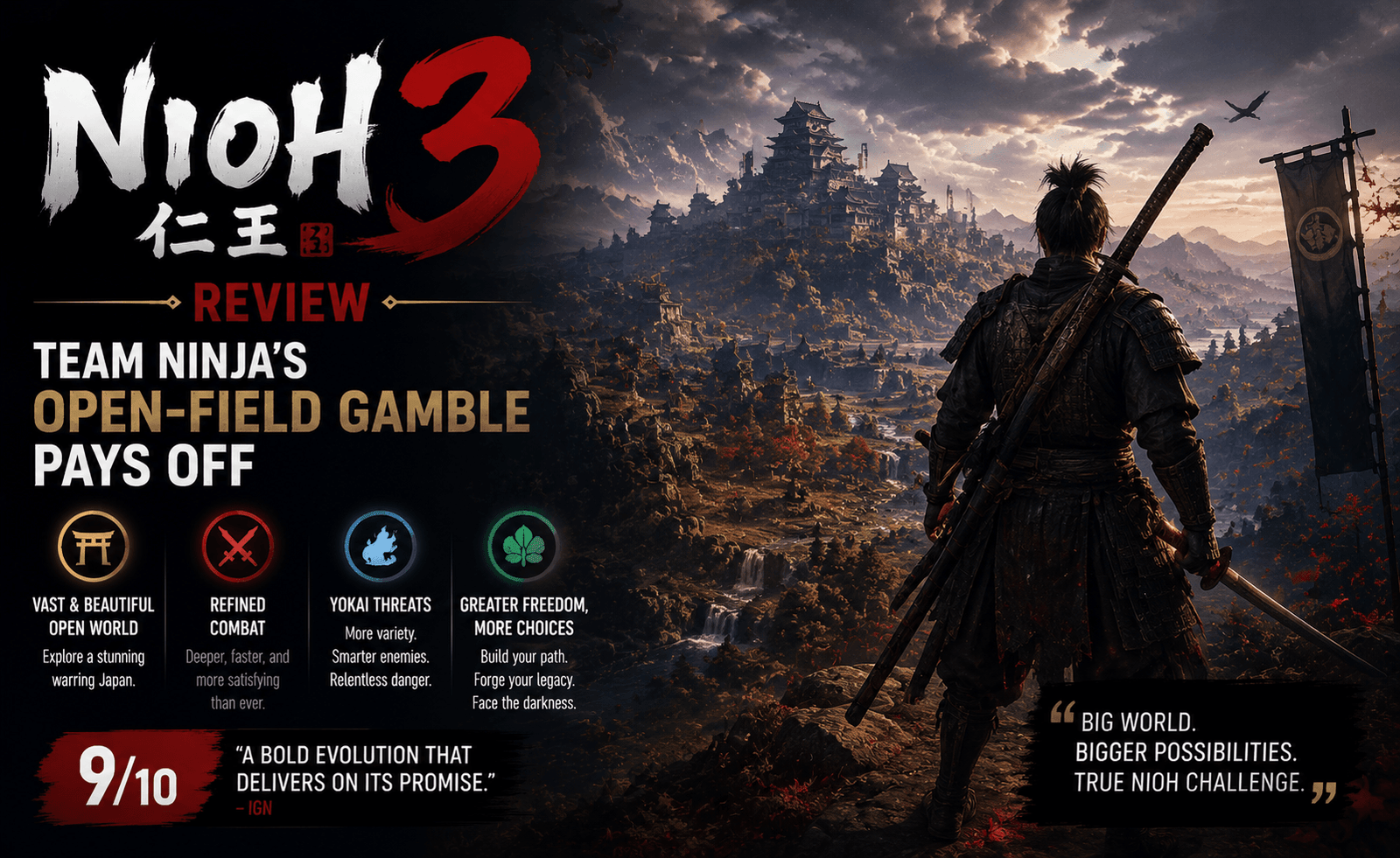
Nioh 3 Review: Team Ninja's Open-Field Gamble Pays Off
Team Ninja has spent nearly a decade perfecting a specific formula: brutally technical melee combat wrapped in mission-based, replayable levels stuffed with loot. Nioh 3 takes the genuinely risky step of pulling that formula out of its comfort zone, introducing open-field regions to explore between the series’ traditional stage-based missions. It’s the most significant structural change in the franchise’s history, and remarkably, it doesn’t cost the series a shred of what made it great.
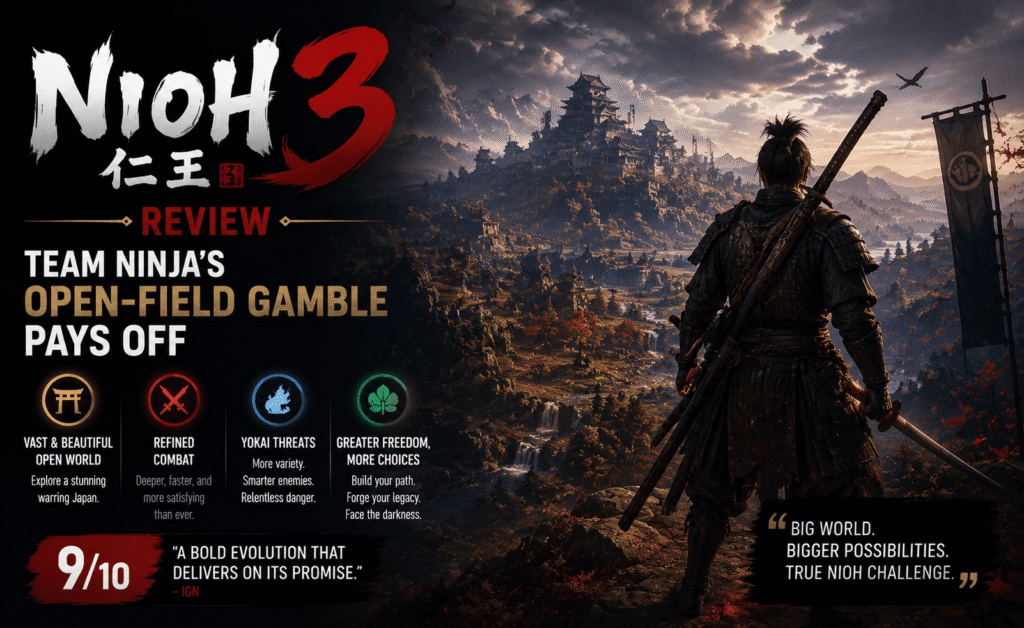
Quick Verdict
The best Nioh has ever played, with open-field exploration adding scope without diluting the series’ trademark difficulty and stance-based depth. A genre high point on PC.
Open Fields Without Losing the Plot
The core worry going into Nioh 3 was obvious: would opening up the world dilute the series’ famously dense, curated mission design? The answer, thankfully, is no. Team Ninja hasn’t abandoned its mission-based DNA; it’s layered open exploration on top of it. Sprawling regions connect discrete, hand-crafted mission areas, giving you room to hunt Yokai, discover shrines, and stumble into optional skirmishes between the tightly designed setpiece levels the series has always excelled at.
This hybrid approach works because Team Ninja understood the assignment: the open-field sections exist to add texture and discovery, not to pad runtime with copy-pasted checklist content. Exploration rewards you with meaningful gear, lore fragments that actually deepen the sengoku-era setting, and shortcuts back to previously cleared missions — the connective tissue feels purposeful rather than obligatory.
Combat: The Series’ Best Iteration Yet
Combat remains the reason to play a Nioh game, and the third entry refines the stance-switching, ki-pulse rhythm that’s defined the series without reinventing it wholesale. The addition of a new hybrid stance — letting you blend mid and high-stance properties on the fly — adds a genuine new layer of decision-making to what was already one of the deepest action combat systems in gaming. Yokai Shift abilities return with expanded movesets, and the game does a better job than its predecessors of teaching you when to use them defensively versus offensively.
The enemy and boss roster leans hard into Japanese folklore and historical figures, and several late-game bosses rank among the series’ best-ever encounters — multi-phase fights that demand you master multiple stances and yokai abilities in tandem rather than finding one cheese strategy and repeating it. Difficulty remains punishing by design, but the game’s ki-pulse recovery system continues to be one of the smartest “soulslike” innovations in the genre, rewarding aggressive, rhythmic play over pure caution. The addition of the hybrid stance in particular changes how veteran players will approach fight preparation, since it’s now viable to build an entire loadout around fluidly transitioning between stance properties mid-combo rather than committing to a single stance’s strengths for an entire encounter.
Loot, Builds, and the Grind
Gear generation returns in familiar Diablo-adjacent form — a relentless stream of weapons and armor with rolled stats, set bonuses, and soul cores that let you graft yokai abilities onto your build. It’s a system that can feel overwhelming early on, but the revamped smithing and reforging interface makes build experimentation far less tedious than in Nioh 2. If you enjoy min-maxing a build around a specific stance or weapon type, there’s dozens of hours of viable theory-crafting here even after the credits roll.
New Game Plus, predictably, ramps difficulty and enemy density considerably, and the open-field regions get meaningfully harder rather than just reused wholesale — new Yokai variants and ambush patterns keep even familiar terrain feeling dangerous on repeat playthroughs.
Presentation and PC Performance
Visually, Nioh 3 is a clear step up from its predecessors, with the open-field regions in particular showing off some genuinely striking sengoku-era vistas — mist-choked forests, burning castle towns, rice paddies lit by lantern-light during night missions. Character and yokai design remain a series highlight, blending body horror with traditional Japanese folklore in ways few other developers attempt.
On PC, performance is strong across the board. The game targets and holds 60fps comfortably on mid-range hardware at 1440p, with an unlocked framerate option that scales well past that on enthusiast systems. Team Ninja has clearly learned from past PC ports — texture streaming issues that plagued Nioh 2’s PC launch are absent here, load times are near-instant off an SSD, and keyboard-and-mouse support, while still secondary to controller play, is functional enough for players without a gamepad handy. Ultrawide support is present and properly implemented rather than stretched.
Story and Setting
Nioh 3 continues the series’ tradition of blending real sengoku-era history with supernatural folklore, following a new protagonist whose fate is entangled with several of the most consequential figures of the period. The narrative remains dense, front-loading a lot of historical exposition that will reward players already familiar with the era and occasionally overwhelm those who aren’t. That said, the game does a better job than its predecessors of contextualizing events for newcomers, with an expanded in-game glossary and optional codex entries that don’t require pausing a wiki tab alongside your playthrough.
The open-field regions do double duty as world-building tools here, letting environmental storytelling — abandoned shrines, battle-scarred villages, roadside yokai encounters — carry narrative weight that the previous games’ mission-select structure couldn’t accommodate as naturally.
Accessibility and Difficulty Options
Team Ninja has made modest but meaningful accessibility improvements this time around, including adjustable enemy aggression settings and a more generous (though still optional) assist mode for players who want to experience the story without mastering every stance-switching nuance. Purists can ignore these entirely; the base difficulty curve remains as demanding as ever, and NG+ cycles push well past what most action games ask of players willing to chase true mastery.
Who Should Play This
This is an easy recommendation for existing Nioh and Souls-like fans, and the open-field additions make it a slightly friendlier entry point for genre newcomers than its predecessors, provided you’re prepared for a genuinely steep learning curve. Players who bounced off Nioh 2’s dense itemization systems should know the smithing overhaul goes a long way toward addressing that specific complaint.
Recommended PC Specs
Nioh 3 is comfortably one of the better-optimized action titles this year. An RTX 3070-class GPU handles 1440p/60fps at high settings without issue, and even older RTX 20-series or equivalent AMD cards can sustain a solid 1080p/60fps experience at medium-high settings. 16GB of RAM is sufficient, though we’d recommend 32GB if you plan on running the game alongside streaming or recording software, since background processes had a slightly larger impact on frame consistency than we’d expect from a well-optimized port. An SSD is strongly recommended for the open-field regions specifically, where mechanical drives showed occasional texture streaming hitches during fast horseback traversal.
Multiplayer and Co-op
Cooperative play returns in familiar form, letting up to three players tackle missions together with shared loot rules that avoid the frustration of watching a rare drop go to a teammate. The open-field regions extend this further, allowing spontaneous drop-in assistance during exploration rather than requiring a formal mission invite, which makes the new structure feel considerably more communal than previous entries. Dedicated PvP modes remain absent, in keeping with series tradition, but the co-op-focused design has always been where Nioh’s multiplayer identity lives, and that remains true here. Matchmaking for open-field regions specifically felt quick and reliable across our testing window, with minimal wait times even outside of peak hours.
Pros and Cons
| Pros | Cons |
|---|---|
| Open-field design adds scope without diluting mission quality | Build/loot systems remain intimidating for genre newcomers |
| New hybrid stance meaningfully deepens combat | Some open-field skirmishes recycle enemy placements |
| Best boss roster in the series | Story remains dense with historical/lore exposition |
| Strong, well-optimized PC port | Steep difficulty curve remains unforgiving for casual players |
Closing Thoughts
What makes Nioh 3 stand out isn’t any single new feature so much as the discipline behind how those features were integrated. It would have been easy for Team Ninja to chase the open-world trend wholesale and dilute the tightly curated mission design that made the series’ reputation in the first place. Instead, the open-field regions were clearly designed as connective tissue in service of the missions, not a replacement for them, and that restraint is exactly why the pivot works as well as it does. Combined with the deepest combat system the series has produced and a boss roster that consistently challenges even genre veterans, this is a sequel that expands its scope without losing sight of what made the foundation worth building on.
Final Verdict
Nioh 3 takes a real structural risk and lands it. By treating open-field exploration as connective tissue rather than a replacement for its mission-based roots, Team Ninja has built the most complete, confident entry in the series — deeper combat, a stronger boss lineup, and a PC port that finally gets the technical fundamentals right from day one.
Topiry Score: 9.0 / 10 — The best Nioh game yet, and one of the year’s essential action titles.
About the Author