

 Topiry



Ubisoft’s CEO Defends Sony’s Plan to Kill PlayStation Discs by 2028
Ubisoft's CEO Defends Sony's Plan to Kill PlayStation Discs by 2028
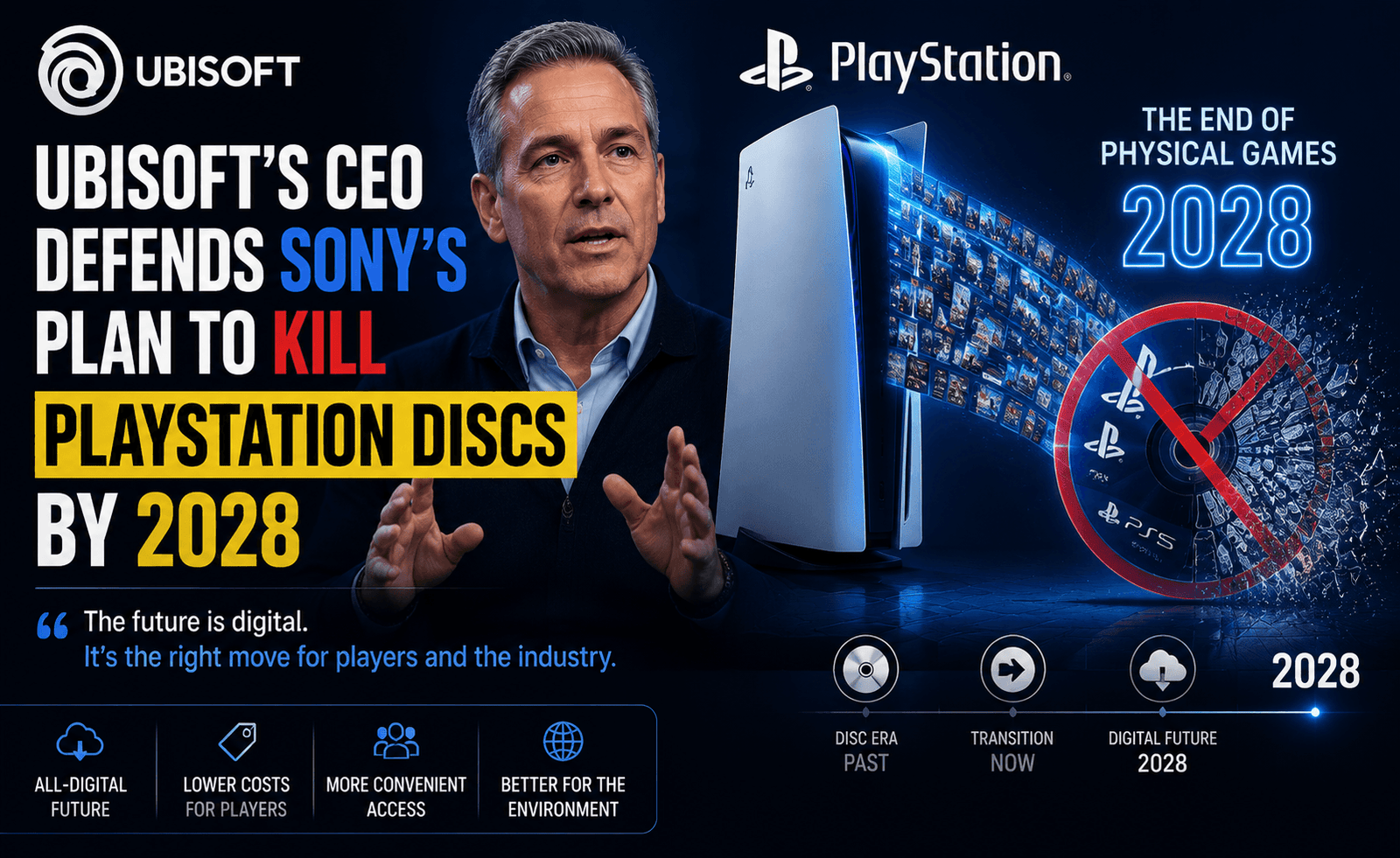
Sony’s decision to phase out physical PlayStation game discs starting in January 2028 has been one of the more divisive announcements in console gaming this year, and this week it picked up a notable, if not entirely surprising, defender. Ubisoft CEO Yves Guillemot used his company’s latest earnings call to argue that the shift to an all-digital PlayStation won’t meaningfully disrupt the industry, drawing a direct comparison to how PC gaming handled its own move away from physical media years ago.
- Sony confirmed earlier this month that all PlayStation games released after January 2028 will be digital-only.
- Ubisoft CEO Yves Guillemot addressed the change during the company’s fiscal Q1 earnings call.
- Guillemot argued the shift mirrors what happened on PC, where all-digital distribution helped the market grow.
- Physical game sales in the US have been declining steadily since peaking back in 2009, according to industry tracking firm Circana.
- Critics point to lost used-game markets, reduced consumer ownership rights and game preservation concerns as the trade-offs.
What Sony Actually Announced
Earlier this month, Sony confirmed plans to stop producing new PlayStation games on physical discs starting in January 2028, citing changing purchasing habits among its user base. The company has pointed out that the large majority of PS5 game purchases already happen digitally, framing the move as a reflection of where consumer behavior already sits rather than an attempt to force a change nobody wants. Xbox, for its part, has reportedly been exploring ways to preserve access to previously purchased physical games as it pursues its own longer-term all-digital ambitions, suggesting Sony isn’t alone in eyeing this direction.
The announcement has not been received warmly by much of the PlayStation community. Social media posts from Sony’s official accounts have been consistently met with pushback from players raising concerns about losing the ability to resell, lend or simply hold onto a physical copy of a game they’ve paid for, along with worries about long-term game preservation once titles exist only as licenses tied to a single digital storefront.
Guillemot’s Case for Going All-Digital
Speaking during Ubisoft’s recent financial call, Guillemot was asked directly how the publisher views Sony’s decision and whether it has any concerns about the ripple effects, including the disappearance of a secondhand market that has historically let players trade in games and put that value toward new purchases. His response leaned firmly toward the optimistic side: he pointed to the PC market’s own transition to all-digital distribution as evidence that a similar shift on PlayStation could help rather than hurt the broader business.
Guillemot also raised a hardware cost argument, suggesting that removing a disc drive from console manufacturing makes the machines themselves cheaper to build, which he framed as a step toward more accessible hardware pricing over time. He acknowledged the change comes with both advantages and drawbacks, but landed on the position that it ultimately won’t disturb the industry to any significant degree.
The Case Against That Optimism
The comparison to PC gaming has drawn plenty of pushback of its own. Unlike PlayStation, where the only official digital storefront is Sony’s own PlayStation Store, PC players have always had multiple competing platforms to buy from, including Steam, GOG and the Epic Games Store, which keeps at least some competitive pressure on pricing. A single-storefront digital console market doesn’t offer players that same alternative, meaning pricing power sits far more concentrated in the platform holder’s hands.
There’s also a straightforward financial incentive at play that goes beyond manufacturing costs. Digital sales tend to be more profitable per copy for both platform holders and publishers, since there’s no physical production, distribution or retail markup to share. That means Sony, and publishers like Ubisoft selling through its storefront, stand to earn more per unit sold as physical retail disappears, even accounting for any customers lost along the way. Whether any of those savings from cheaper, disc-free hardware actually get passed down to consumers in the form of lower prices remains an open question that Guillemot’s comments didn’t directly address.
An Awkward Messenger, According to Some Critics
Guillemot’s endorsement has landed somewhat differently given Ubisoft’s own recent track record. The publisher has weathered a rough multi-year stretch marked by delayed and cancelled projects, studio closures, layoffs and a steep decline in its stock price compared to where it traded several years ago. That backdrop has led some observers to question how much weight Ubisoft’s perspective should carry on a debate about what’s good for the broader industry, given the company’s own struggles executing its core business over the same period.
Others have noted a layer of irony in Ubisoft downplaying concerns about digital ownership and game longevity, pointing to the publisher’s history of shutting down servers for various online-dependent titles over the years — a preservation issue that critics argue becomes even more pronounced once physical backups of games are no longer an option at all.
The Bigger Picture for the Industry
Sony’s move, and Ubisoft’s public endorsement of it, both fit into a longer-running trend of console gaming edging closer to the all-digital model that PC has operated under for well over a decade. High-profile upcoming titles are already leaning into that shift directly — Grand Theft Auto VI, for instance, is planned as digital-only from the outset, regardless of what happens with PlayStation’s disc timeline.
What remains unresolved is how the industry handles the trade-offs that come with losing physical media entirely: the used game market that gave budget-conscious players a way to access more titles, the ability to resell or lend games, and the long-term question of game preservation once every copy of a title exists only as a license on a server the player doesn’t control. Guillemot’s comments suggest at least one major publisher isn’t losing sleep over those questions. Whether players, and the rest of the industry, end up feeling the same way by the time Sony’s January 2028 deadline actually arrives is still very much up for debate.
What Happens to the Games Already on Your Shelf
Sony’s announced change only applies to new releases going forward from January 2028; it doesn’t retroactively disable existing physical discs or the ability to play games people already own on a PS5 with a disc drive. That distinction matters, since much of the public anxiety around the announcement has understandably centered on what happens to existing collections rather than future purchases. Older PS5 consoles with disc drives, and the PS5 Digital Edition variants that already ship without one, will presumably continue to coexist on the market until Sony phases out disc-drive hardware entirely, a timeline the company hasn’t detailed in as much depth as the software side of the transition.
The more pressing long-term concern raised by preservationists isn’t really about today’s players, most of whom already own working hardware, but about accessibility for anyone trying to experience these games years or decades from now. A physical disc, whatever its other limitations, remains playable as long as compatible hardware exists and the disc itself isn’t damaged. A digital license tied to an account on a storefront that a company could, in theory, discontinue or restrict access to down the line doesn’t offer the same guarantee, a concern that predates this specific announcement but that becomes considerably more acute once physical backups stop being produced at all.
How Other Publishers Have Responded
Guillemot’s remarks stand out partly because they’re a rare instance of a major publisher CEO speaking so directly and favorably about the shift, rather than staying neutral on a topic that’s clearly unpopular with a vocal segment of the player base. Other major publishers have largely avoided commenting on Sony’s announcement in as much detail, a silence that could reflect genuine indifference, a desire to avoid public backlash, or simply the fact that fewer investor calls happened to prompt the question directly in the days following Sony’s announcement.
Industry veterans outside the traditional publisher camp have offered a more mixed take. Some have echoed the financial logic Guillemot laid out, framing the move as an inevitable consequence of digital distribution economics that were always going to catch up with consoles eventually, given how thoroughly digital sales already dominate. Others have specifically called out the loss of the used games market as a financial necessity dressed up as a consumer benefit, arguing that whatever accessibility gains come from cheaper hardware will likely be outweighed, for many players, by the loss of resale value and secondhand affordability that physical media has traditionally provided.
The Road to January 2028
With roughly eighteen months remaining before Sony’s disc-free policy takes effect for new releases, there’s still time for the conversation to shift, whether through consumer pushback, competitive pressure from Xbox’s own approach to legacy game access, or simply further clarification from Sony about how pricing and accessibility will actually work once the transition happens. Guillemot’s comments this week give a clear early signal of where at least one of the industry’s largest publishers stands, but plenty of other major voices in gaming have yet to weigh in publicly with the same level of detail, and how the broader industry positions itself over the coming months will likely shape how smoothly, or roughly, the actual transition goes over the next year and a half.
About the Author